
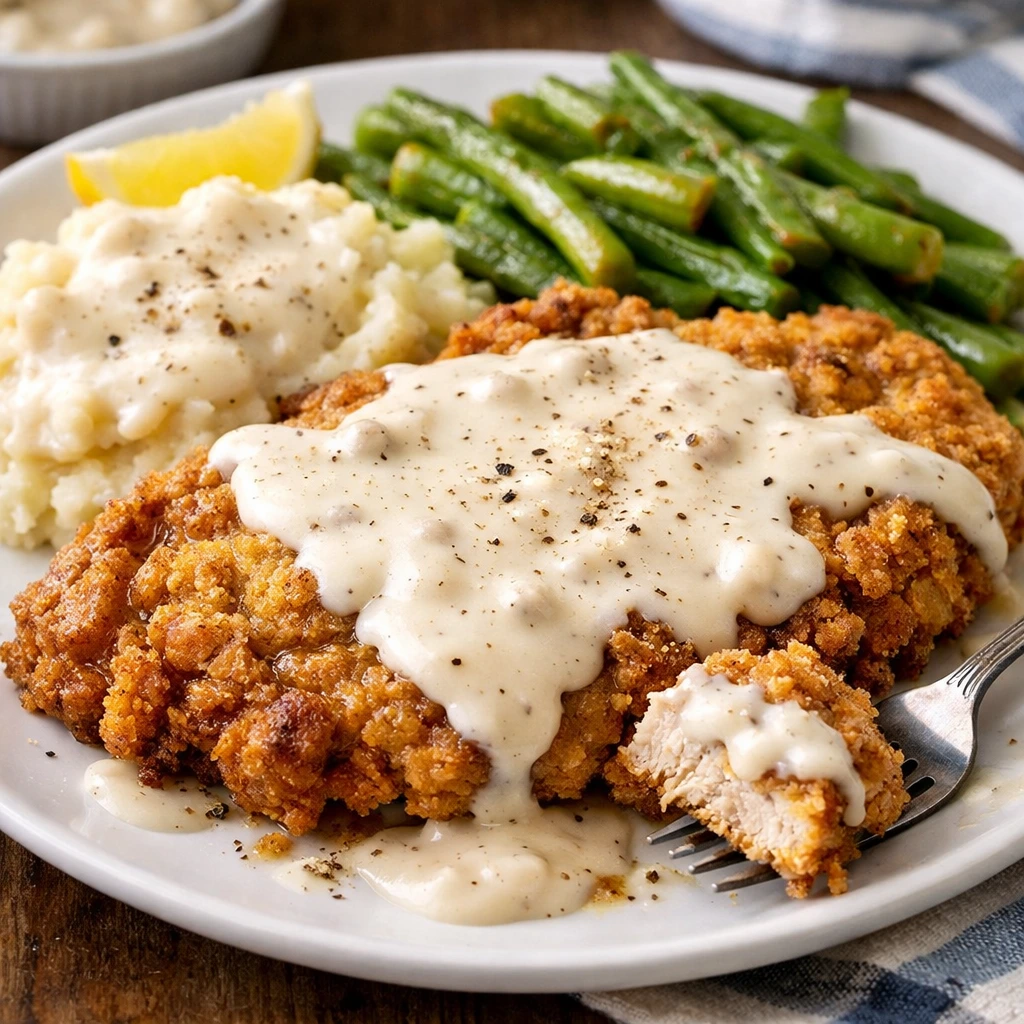

What Is Chicken Fried Steak (And Why Is It Called That)?
Chicken fried steak is a Southern American dish made from a thin, tenderized cut of beef — most often cube steak or round steak — that’s been seasoned, dredged in a seasoned flour coating, dipped in an egg-and-buttermilk batter, coated again in flour, and then pan-fried in oil until deeply golden and shatteringly crisp. It’s served, always, with a generous ladle of cream gravy made from the pan drippings.
So why “chicken” fried steak? Because it’s cooked exactly the way you’d fry chicken. The technique — battering and frying in shallow oil — is identical to classic Southern fried chicken. The only difference is what’s inside the crust. Swap the chicken for beef, keep the coating and the method exactly the same, and you have chicken fried steak.
It’s worth distinguishing this from its close cousin, country fried steak. The two are often used interchangeably, but there is a meaningful regional difference: chicken fried steak traditionally features a crispy, crunchy coating and is served with white (cream) gravy poured directly over the top. Country fried steak tends to have a simpler, softer coating and is served with brown gravy, often on the side. Both are excellent. Both are deeply American. But if you’re going for the full, iconic experience, chicken fried steak with white pepper gravy is the one.
A Brief, Delicious History
Chicken fried steak is a dish born of practicality and ingenuity, and its origins are rooted firmly in the American South and Southwest — specifically in Texas, where it became a cultural institution.
The dish’s roots trace back to the waves of German and Austrian immigrants who settled in Texas during the mid-19th century, bringing with them a tradition of breaded and fried thin cutlets known as Wiener Schnitzel. As these immigrants encountered the beef-rich landscape of the Texas frontier — where cattle were abundant but premium cuts were expensive and less tender cuts were plentiful — they adapted the schnitzel technique to tougher, cheaper beef. Pounding the meat thin broke down the muscle fibers, making an otherwise chewy cut surprisingly tender. Coating it in a fried crust kept it juicy. The technique was brilliant.
The dish grew alongside the Texas cattle economy throughout the late 1800s and early 1900s, picking up Southern American fried chicken traditions along the way — the buttermilk batter, the seasoned flour, the black pepper cream gravy. By the time the mid-20th century rolled around, chicken fried steak had become deeply woven into Texas diner culture. It appeared on virtually every meat-and-three lunch counter menu from Amarillo to Austin.
In 2011, the Texas State Legislature officially designated chicken fried steak as a significant component of Texas cuisine — a recognition that felt less like a political declaration and more like a statement of the obvious to anyone who’d grown up eating it. Today it remains one of the most recognized comfort food dishes in American cooking, beloved from small-town diners to upscale Southern restaurants that serve elevated interpretations alongside locally sourced sides.
The Best Cut of Meat to Use
The cut of beef you choose determines whether your chicken fried steak is fork-tender and satisfying or tough and disappointing. Here’s what actually works:
Cube Steak (The Traditional Choice)
Cube steak is the undisputed classic. It’s typically cut from the top round or top sirloin, then run through a mechanical tenderizer that punctures the surface in a grid pattern — which is where the name comes from, since those punctures look like a grid of small cubes. This process breaks down the tough muscle fibers before the steak ever hits the pan. Cube steak is inexpensive, readily available at virtually every grocery store, already the right thickness (usually around 1/4 to 3/8 inch), and designed for exactly this kind of high-heat, short-fry cooking. It’s what your grandmother used, and it’s what most great diners still use today.
Bottom Round Steak (DIY Tenderizing)
If you want more control over thickness and size, buy a bottom round steak and pound it yourself with a meat mallet to about 1/4 inch thin. Bottom round is lean and tough in its natural state, but aggressive pounding breaks down the connective tissue dramatically. Some cooks prefer this approach because it gives you slightly more texture and a cleaner beefy flavor than pre-tenderized cube steak.
Top Sirloin, Thin-Cut
For a slightly more premium version, thin-cut top sirloin pounded to 1/4 inch produces a chicken fried steak with a richer, more pronounced beef flavor. It’s not the traditional approach, but it’s a legitimate upgrade for a special occasion version of the dish.
Whatever you choose, the critical factor is thickness: no more than 1/4 to 3/8 inch. Thicker steaks won’t cook through before the coating burns. Thinner steaks are actually better here — the coating does the heavy lifting, and the meat inside just needs to cook through quickly in the hot oil.
5 Secrets to a Perfectly Crispy Coating
The coating is everything. Here’s what separates an extraordinary crust from a pale, greasy disappointment:
1. Double-Dredge, Always
A single coat of flour won’t give you the thick, shatteringly crisp crust that defines a great chicken fried steak. The right approach is a two-stage dredge: flour first, then an egg-and-buttermilk wash, then flour again. That second coat of flour sticks to the wet wash and creates a shaggy, irregular surface that fries up with dramatically more crunch and more surface area than a single dip ever could. Don’t be shy — press that second flour coat firmly into the meat.
2. Season Every Layer
Amateur chicken fried steak seasons only the flour. Great chicken fried steak seasons the meat itself, the flour mixture, and the egg wash. You want flavor in every single layer — not just on the surface. The seasoning blend for the flour should include salt, lots of black pepper, garlic powder, onion powder, smoked paprika, and a pinch of cayenne. The meat gets a direct seasoning of salt and pepper before it touches anything else.
3. Use Buttermilk in the Egg Wash
Plain egg works, but a mixture of egg and buttermilk does something remarkable. The acidity in the buttermilk helps tenderize the outer layer of the meat slightly, and its thickness helps the second flour coat cling more aggressively. It also contributes a subtle tang that elevates the overall flavor of the crust. If you don’t have buttermilk, combine regular milk with a teaspoon of white vinegar or lemon juice and let it sit for five minutes — it curdles slightly and works just as well.
4. Rest the Coated Steaks Before Frying
After the double-dredge, place the coated steaks on a wire rack and let them rest for 10–15 minutes before they go into the oil. This resting period allows the coating to hydrate and adhere to the meat more firmly. Steaks that skip this step tend to lose their coating in the oil — it slides off in chunks rather than staying locked to the surface.
5. Oil Temperature Is Non-Negotiable
Fry in oil maintained between 340°F and 360°F (171°C–182°C). Too hot and the crust burns before the meat cooks through. Too cool and the coating absorbs oil and becomes greasy and heavy instead of light and crisp. Use a deep-fry or candy thermometer to monitor the temperature, and let the oil return to temperature between batches — adding cold steaks drops the oil temp rapidly. A cast iron skillet is the ideal vessel here: its superior heat retention keeps the temperature more stable than thin stainless or aluminum pans.
The White Gravy: Don’t Skip It, Don’t Rush It
No component of this dish is optional, but if there’s one element that truly defines a great chicken fried steak from a mediocre one, it’s the gravy. A thin, flavorless cream sauce doesn’t cut it. What you’re after is a rich, spoonable white pepper gravy — deeply savory from the pan drippings, thickened to a coat-the-back-of-a-spoon consistency, and aggressively seasoned with black pepper. It should be poured over the entire steak, not served politely on the side.
The Key to Gravy Depth: Those Pan Drippings
After frying, you’ll have a pool of hot oil left in the skillet, along with browned bits of coating and rendered meat juices clinging to the bottom of the pan. Don’t pour that out. Those bits — the fond — are where all the flavor in your gravy comes from. Pour off most of the oil but leave about 3–4 tablespoons in the pan along with all of those browned bits. That’s your gravy base.
The Roux: Take Your Time
Add flour to the reserved drippings and whisk over medium heat for a full 2–3 minutes. This step is where most home cooks rush and regret it — undercooking the flour leaves a raw, pasty taste in the finished gravy. Cook the roux until it turns a light golden color and smells faintly nutty. Only then should you add your liquid.
Whole Milk, Not Cream
Traditional white gravy for chicken fried steak is made with whole milk, not heavy cream. Cream produces a gravy that’s too thick and rich — it overwhelms the steak rather than complementing it. Whole milk gives you the right consistency and a clean dairy flavor that plays beautifully against the pepper. Add the milk gradually, whisking constantly to prevent lumps, then let it simmer until thickened.
Pepper: More Than You Think
Southern cream gravy is assertively peppered. Not “a pinch of pepper” peppered — visibly, generously, unmistakably black-pepper-flecked. If your gravy looks pale white with no specks, you haven’t used enough. Start with at least 1 teaspoon of freshly cracked black pepper and taste as you go. Salt is added last, since the drippings themselves carry some saltiness from the fried coating.
Full Chicken Fried Steak Recipe with White Gravy
Yield: 4 servings | Prep Time: 20 minutes | Rest Time: 15 minutes | Cook Time: 20–25 minutes | Total Time: ~1 hour
Ingredients
For the Steaks
- 4 cube steaks (about 5–6 oz each), or 4 pieces of bottom round pounded to ¼-inch thick
- 1 teaspoon kosher salt
- 1 teaspoon freshly cracked black pepper
For the Seasoned Flour
- 2 cups all-purpose flour
- 1½ teaspoons kosher salt
- 1½ teaspoons freshly cracked black pepper
- 1 teaspoon garlic powder
- 1 teaspoon onion powder
- 1 teaspoon smoked paprika
- ¼ teaspoon cayenne pepper
- ½ teaspoon dried thyme
For the Egg Wash
- 2 large eggs
- ¾ cup buttermilk (or ¾ cup whole milk + 1 tsp white vinegar, rested 5 minutes)
- 1 teaspoon hot sauce (optional, but recommended — Frank’s RedHot or Texas Pete)
For Frying
- 1½ to 2 cups vegetable oil, or enough to come ½ inch up the sides of a 12-inch cast iron skillet
For the White Pepper Gravy
- 3–4 tablespoons reserved pan drippings (from frying)
- ⅓ cup all-purpose flour
- 2½ to 3 cups whole milk, warmed
- 1 to 1½ teaspoons freshly cracked black pepper (don’t be shy)
- ½ teaspoon kosher salt, or to taste
- Pinch of cayenne (optional)
Instructions
Step 1: Season the Steaks
If using cube steak, pat dry with paper towels and inspect both sides. If using bottom round, place between two sheets of plastic wrap and pound with the textured side of a meat mallet, working from the center outward, until uniformly ¼-inch thin. Season both sides of each steak with kosher salt and cracked black pepper. Set aside.
Step 2: Set Up Your Dredging Station
You’ll need three shallow vessels — wide bowls, pie plates, or rimmed baking dishes all work well. In the first, combine the flour with all the seasonings and whisk to distribute evenly. In the second, whisk together the eggs, buttermilk, and hot sauce until smooth. Leave the third empty — that’s your landing zone for the coated steaks before they go into the oil.
Step 3: Double-Dredge Each Steak
Working one steak at a time, press it into the seasoned flour and coat both sides completely, shaking off any excess. Drop it into the egg wash, turning to coat fully and letting any excess drip off. Then press it back into the flour for a second coat, this time pressing firmly with your palm to ensure the coating adheres to every surface — including the edges. You want a thick, slightly shaggy, uneven coating with no bald spots. Place the coated steak on the wire rack over the empty baking sheet and repeat with the remaining steaks.
Step 4: Rest the Coated Steaks
Let the breaded steaks rest on the wire rack at room temperature for 10–15 minutes. This is not optional — this is where the coating bonds to the surface and becomes structurally sound enough to survive the oil. If you skip this step, you risk the coating separating during frying.
Step 5: Heat the Oil
Pour vegetable oil into a large (12-inch) cast iron skillet to a depth of about ½ inch. Heat over medium-high heat until the oil reaches 350°F (175°C) on a deep-fry thermometer. To test without a thermometer: drop a pinch of flour into the oil — if it sizzles immediately and floats to the surface, you’re ready. If it sinks or does nothing, the oil needs more time. If it immediately turns dark, the oil is too hot — reduce the heat and let it cool slightly.
Step 6: Fry the Steaks
Carefully lower the steaks into the hot oil one or two at a time — do not crowd the pan. Overcrowding drops the oil temperature too far and results in greasy, soggy coating instead of crispy crust. Fry for 3–4 minutes on the first side without touching or moving the steak. You’re looking for a deep golden-brown color on the underside before you flip — resist the urge to check early, as the coating needs to set completely before it will release from the pan naturally. Flip once and fry the second side for another 2–3 minutes until equally golden. The internal temperature of the meat should read at least 160°F.
Step 7: Drain and Keep Warm
Transfer fried steaks to a clean wire rack set over a baking sheet and place in a 200°F oven to keep warm while you fry the remaining steaks and make the gravy. Never drain on paper towels — they trap steam against the bottom of the steak and make it soggy. A wire rack keeps the bottom crust just as crispy as the top.
Step 8: Make the White Pepper Gravy
Carefully pour off most of the oil from the skillet into a heatproof container, leaving 3–4 tablespoons of drippings and all the browned bits in the pan. Return the skillet to medium heat. Sprinkle in the flour and whisk immediately to combine with the drippings, scraping up any browned bits from the bottom of the pan. Cook this roux, whisking constantly, for 2–3 minutes until it turns a light golden color and smells nutty — this cooks out the raw flour taste and deepens the gravy’s flavor.
Begin adding the warmed whole milk gradually — start with about ½ cup, whisking vigorously to prevent lumps from forming, then add another ½ cup and whisk again. Continue adding milk in ½-cup increments until the gravy reaches a smooth, pourable but thick consistency that coats the back of a spoon. This takes about 5–6 minutes of simmering and whisking. Season generously with cracked black pepper — you want it visibly flecked — then add salt and cayenne to taste. Taste and adjust. The gravy should be boldly seasoned.
Step 9: Plate and Serve
Place each chicken fried steak on a warm plate and ladle the white pepper gravy generously over the top — don’t hold back. The gravy goes over the steak, not around it. Serve immediately alongside your choice of classic Southern sides.
Quick Reference: Frying Temperature Guide
| Oil Temperature | What Happens | Result |
|---|---|---|
| Below 325°F | Oil absorbs into coating before crust sets | Greasy, soggy, heavy — not ideal |
| 325°F – 340°F | Crust forms slowly; decent result | Good but not exceptional crunch |
| 340°F – 360°F ⭐ | Crust sets immediately; moisture stays inside | The golden zone — maximum crunch, juicy interior |
| Above 375°F | Exterior burns before interior cooks through | Dark crust, undercooked center |
Pro Tips, Make-Ahead Notes, and Variations
Make-Ahead Tips
Chicken fried steak is best eaten immediately after cooking, but there are a few ways to work ahead. You can season and pound the steaks a day in advance and store them covered in the refrigerator. You can also prepare the seasoned flour mixture up to a week ahead and keep it in an airtight container. The gravy can be made ahead and reheated gently over low heat with a splash of milk to restore its consistency. The steaks themselves do not reheat as well — the crust softens in any microwave or covered pan environment — so plan to fry them fresh.
Reheating Without Sacrificing the Crust
If you must reheat, do it in the oven. Place leftover chicken fried steaks on a wire rack over a baking sheet and heat at 375°F for 8–12 minutes until heated through and the crust has re-crisped. It won’t be quite as good as fresh, but it’s vastly superior to the microwave. Reheat gravy separately on the stovetop.
Spicy Variation
For a Nashville-hot-inspired twist, add 1 tablespoon of cayenne, 1 teaspoon of chili powder, and 1 teaspoon of brown sugar to the seasoned flour. Immediately after frying, brush each steak with a mixture of 2 tablespoons of the hot frying oil whisked with 1 tablespoon of cayenne and 1 teaspoon of smoked paprika. It gives you a gorgeous red-orange sheen and a slow, building heat that works brilliantly with the cool richness of the white gravy.
Gluten-Free Adaptation
A 1:1 gluten-free all-purpose flour blend works reasonably well in both the dredge and the gravy, though the crust will be slightly less shatteringly crisp than the wheat version. Adding 2 tablespoons of cornstarch to the gluten-free flour blend helps approximate the crunch. Rice flour alone can also be used for the dredge — it produces an exceptionally crispy, light crust with a texture that some cooks actually prefer to the wheat version.
Air Fryer Version
The air fryer will not reproduce the full glory of a pan-fried version, but it produces a respectable weeknight result. Coat the steaks as directed, spray generously with cooking oil spray on both sides, and air fry at 400°F for 10–12 minutes, flipping once at the halfway point. The crust won’t have the same depth of color or crunch, but it’s significantly lighter and quicker. Make the gravy on the stovetop as directed.
What to Serve with Chicken Fried Steak
Chicken fried steak is comfort food royalty, and it deserves side dishes that can keep up. These are the classics — the combinations that have earned their place on Southern dinner tables for generations.
Mashed Potatoes. The obvious choice — and the correct one. Rich, buttery mashed potatoes serve as a platform for any gravy that slides off the steak, creating a secondary dish within the dish. Don’t make them thin or delicate; make them thick, creamy, and unapologetically indulgent.
Southern Green Beans. Long-cooked with bacon and onion until completely tender and deeply savory — not crisp-tender, not al dente. Southern green beans are cooked until the color is muted and the flavor is concentrated. They’re the ideal contrast to the richness of the steak and gravy.
Buttermilk Biscuits. Fresh, flaky, hot from the oven, and used to sop up any remaining gravy on the plate — an essential part of the full chicken fried steak experience. If you’re going to make them, don’t make them small.
Creamed Corn. Sweet, rich, and slightly starchy, creamed corn provides a gentle sweetness that cuts through the savoriness of the steak and gravy without competing with it.
Coleslaw. A cold, tangy, creamy coleslaw is one of the best foils for a deeply fried, rich dish. The crunch, the acidity, and the cool temperature contrast against the hot steak in a way that refreshes the palate between bites and keeps the meal from feeling heavy.
Pickled Okra or Jalapeños. A small bowl of pickled vegetables on the side is a genuinely excellent — and underused — accompaniment. The bright acid of the pickle cuts through the fat of the fried coating beautifully and adds a distinctly Southern character to the plate.
Frequently Asked Questions
Why does my coating fall off during frying?
There are three main culprits. First, you may have skipped or shortened the resting period after dredging — those 10–15 minutes are essential for the coating to bond to the meat surface. Second, your oil may not have been hot enough; when oil is too cool, the coating absorbs it slowly rather than crisping immediately, and it can slide off before it has a chance to set. Third, you may have moved or jostled the steak too early in the frying process — let it sit undisturbed until the coating releases naturally from the pan, which signals it has crisped and set properly.
Can I use a different cut of steak?
Yes. While cube steak is the traditional choice, bottom round, eye of round, and top round all work well when pounded to ¼-inch thickness. Some cooks prefer the flavor of these cuts over pre-tenderized cube steak. Avoid thick, premium cuts like ribeye or New York strip — they’re better served as steaks, and their cost isn’t justified in a coating this thick. Save the ribeye for another night.
What oil is best for frying chicken fried steak?
Any neutral, high smoke-point oil works well: vegetable oil, canola oil, peanut oil, or refined corn oil. Peanut oil adds a very faint, pleasant nuttiness and has an excellent smoke point (around 450°F). Avoid olive oil — it smokes at lower temperatures and has a distinctive flavor that doesn’t belong here. Traditionalist Southern cooks sometimes use a mixture of vegetable oil and lard, which adds richness and a more complex flavor to the crust.
How do I keep the first batch of steaks warm while I cook the rest?
Place fried steaks on a wire rack set over a rimmed baking sheet and keep them in a 200°F oven. This keeps them hot without continuing to cook them and, critically, keeps the bottom crust crispy by allowing air to circulate underneath. Never stack hot fried steaks on top of each other or tent them with foil — both trap steam and soften the crust you worked so hard to develop.
Can chicken fried steak be baked instead of fried?
Technically, yes — but the result is meaningfully different from the fried original. Baked chicken fried steak won’t develop the same depth of color, the same shatteringly crisp crust, or the same overall satisfaction. If you want to bake, brush the coated steaks generously with melted butter on both sides, place on a wire rack over a baking sheet, and bake at 425°F for 20–25 minutes, flipping once. Spray with additional cooking oil spray at the flip point. It’s a lighter version — perfectly acceptable — but manage expectations: baked and fried are not the same dish.
My gravy keeps getting lumpy. How do I fix it?
Lumpy gravy almost always comes down to two things: adding liquid too quickly, or not whisking vigorously enough. Add the milk in small increments — no more than ½ cup at a time — and whisk constantly and aggressively after each addition before adding more. If you end up with lumps despite this, strain the gravy through a fine-mesh sieve before serving. For truly stubborn lumps, a quick 30 seconds with an immersion blender will smooth it out completely.
Is chicken fried steak actually chicken?
No — there is no chicken in chicken fried steak. The name refers entirely to the cooking method: the steak is prepared using the same breading-and-frying technique as traditional Southern fried chicken. The protein inside the crust is always beef, typically cube steak or a tenderized round steak. The confusion is understandable for anyone unfamiliar with Southern cooking traditions, and it’s one of the most common questions the dish generates.
Final Thoughts
Chicken fried steak is the kind of dish that rewards attention. It looks simple — and in concept, it is — but the details matter enormously. The double-dredge. The rest before frying. The temperature of the oil. The time you give the roux before adding the milk. The amount of black pepper in the gravy. Get these details right and what comes out of your cast iron skillet is something genuinely special: crunchy and tender and rich and peppery and impossibly satisfying all at once.
It’s not a dish that pretends to be refined. It’s never tried to be. Chicken fried steak is proudly, defiantly, joyfully unpretentious — a dish built not from luxury ingredients but from technique and love and the deeply human impulse to take something humble and make it extraordinary.
Make it on a Sunday. Make it for people you care about. Ladle the gravy on thick and don’t apologize for it. That’s how it’s always been done, and there’s a reason it’s been done that way for well over a century.
Made this recipe? We want to hear about it — leave a rating and a comment below! Share a photo on Instagram and tag us so we can see your crispy, gravy-smothered masterpiece. And if you love Southern comfort food, check out our buttermilk biscuit recipe and our guide to the perfect mashed potatoes to round out the full meal.