


La Cuisine Classique · French Cooking for the Modern Kitchen
The Classic Dish That Changed Everything

Julia Child’s
Beef Bourguignon
Boeuf Bourguignon — decoded, annotated, and made achievable
for every home cook who dares to try
⏱ 4 hrs 15 min total|🍷 Serves 6|⭐ Intermediate|📅 Updated March 2026
Prep Time45 min
Cook Time3 hrs 30 min
RestingOvernight
Servings4–6
DifficultyIntermediate
MethodOven Braise
Contents
- The Legend Behind the Dish
- Why Julia Child’s Version Is Different
- Understanding Every Ingredient
- The Complete Recipe — Step by Step
- Key Techniques Explained
- 10 Mistakes to Avoid
- Choosing the Right Wine
- How to Serve & What to Pair
- Make-Ahead, Storage & Reheating
- Frequently Asked Questions
The Legend Behind the Dish
There is a scene from food history that every serious home cook should know. It is 1961. A relatively unknown American woman, who learned to cook in Paris at the age of 36, submits a 726-page manuscript to an editor at Alfred A. Knopf. The book is titled Mastering the Art of French Cooking. Its opening salvo — its very first main course recipe — is Boeuf Bourguignon.
That woman was Julia Child. And that single recipe — a rich, slow-cooked beef stew from Burgundy, France — became the cultural touchstone that convinced an entire generation of American home cooks that French cuisine was not the exclusive province of restaurants and trained chefs, but something deeply possible in the home kitchen.
Today, more than six decades later, Beef Bourguignon remains one of the most searched, most cooked, and most celebrated dishes in the home cooking canon. It is the recipe people attempt when they want to prove something — to dinner guests, to themselves. It is the dish that appears on every “most iconic recipes ever written” list. And it all comes back to Julia.
“This is the sort of slowly simmered beef stew which has actually been carefully cooked.”— Julia Child, Mastering the Art of French Cooking, 1961
This article is your complete guide to Julia Child’s Beef Bourguignon — not just the recipe, but the philosophy behind it, the techniques that make it extraordinary, the mistakes that ruin it, and the secret that most home cooks never discover: that this dish is almost always better the day after it’s made.
Why Julia Child’s Version Is Different
Beef Bourguignon existed long before Julia Child wrote about it. It is a peasant dish from the Burgundy region of eastern France — a practical solution to tougher cuts of beef that needed hours of wine and aromatics to become tender. Traditional French farmhouse cooks had been making some version of it for centuries.
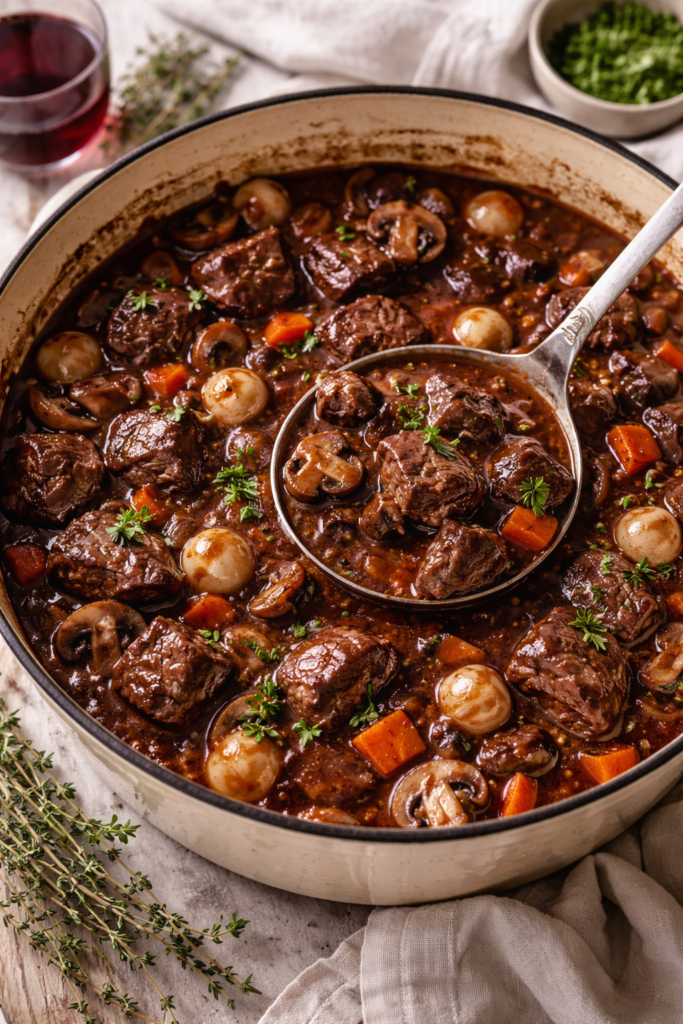
So what makes Julia’s version different? The answer comes down to three things: the architecture of the recipe, the attention to detail, and the insistence on doing each component separately.
- The meat is dried and seared individually — not crowded into a pan and steamed. This is non-negotiable for proper browning.
- The pearl onions and mushrooms are cooked in separate pans and added at the end, preserving their individual textures and flavors.
- The lardons are blanched before being rendered, removing harsh salt and smoke that would otherwise overwhelm the wine sauce.
- The finished braise is strained and the sauce is reduced separately, concentrating it to a silky, coating consistency before being reunited with the beef.
- The wine is a full bottle — not a splash. Burgundy is not a supporting actor in this dish; it is the co-lead.
Most shortcut versions of Beef Bourguignon throw everything in a pot together. They taste fine. Julia’s version, cooked properly, tastes like it came from a restaurant in Lyon. The difference is process — and the good news is that the process, though multi-step, is entirely accessible to any patient home cook.
Understanding Every Ingredient
Before we cook, we need to understand what we’re working with. In French cuisine — Julia’s tradition — every ingredient has a role. Nothing is accidental. Here’s a closer look at the cast of characters that makes this dish work.
The Beef: What to Buy and Why It Matters
Julia calls for stewing beef — and specifically recommends cuts that have abundant connective tissue and intramuscular collagen. Beef chuck (shoulder) is the gold standard: it has enough marbling to stay moist during the long braise, and its connective tissue dissolves into gelatin that gives the finished sauce its characteristic body and sheen. Avoid leaner cuts like round or sirloin, which will turn dry and stringy over three hours of heat.
Cut the beef into 2-inch cubes — larger than you might expect. They will shrink significantly during cooking, and a too-small piece of beef becomes mealy and overcooked before the sauce has time to develop.
Lardons: The Flavor Foundation
Lardons are small batons of thick-cut, salted pork — essentially diced slab bacon. They serve two purposes: their fat is used to brown the beef, and their crisped pieces become textural pockets of pork flavor distributed throughout the stew. Julia’s instruction to blanch them first — simmer them in water for 10 minutes — is a step most American adaptations omit. It’s a mistake to skip: blanching removes excess salt and the sharp smokiness that American bacon can have, which would otherwise make the finished sauce acrid.
The Wine: Burgundy or Not?
The dish takes its name from the Burgundy region, and traditionally calls for Burgundy wine — specifically a Pinot Noir from Côte de Nuits or Côte de Beaune. In practice, a full bottle of any good, full-bodied dry red wine will produce an excellent result. We discuss wine selection in detail later in this article. The cardinal rule: never use a wine you wouldn’t drink.
On Bouquet Garni
A bouquet garni is a bundle of herbs — traditionally thyme, bay leaf, and parsley stems — tied together with kitchen twine (or wrapped in a cheesecloth pouch) and submerged in the braise. It perfumes the sauce during cooking without leaving loose herb bits throughout. Julia includes one in her recipe, and it contributes a subtle herbal backdrop that would be noticeably absent without it.
✦ ✦ ✦
The Complete Recipe
Julia Child’s Beef Bourguignon
Boeuf Bourguignon à la Façon de Julia Child
Prep45 min
Braise3 hrs
Serves4–6
WineBurgundy
Best MadeDay Before
Ingredients
The Braise
- 3 lbs beef chuck, cut into 2-inch cubes, thoroughly dried
- 6 oz lardons (thick-cut slab bacon, cut into ¼-inch batons)
- 1 bottle dry red Burgundy wine (or good Pinot Noir / Côtes du Rhône)
- 2–3 cups beef stock, heated (enough to barely cover the beef)
- 1 tbsp tomato paste
- 1 large carrot, sliced into ½-inch rounds
- 1 large white or yellow onion, roughly sliced
- 4 cloves garlic, smashed and peeled
- 3 tbsp all-purpose flour
- 2 tbsp olive oil or vegetable oil
- 1 bouquet garni (4 thyme sprigs, 2 bay leaves, 6 parsley stems, tied)
- — Kosher salt and freshly ground black pepper
Braised Pearl Onions (Oignons Glacés)
- 18–24 fresh pearl onions (or frozen, thawed and dried)
- 1½ tbsp unsalted butter
- 1½ tbsp olive oil
- ½ cup beef stock or water
- 1 small bouquet garni (thyme + bay)
- — Salt and pepper to taste
Sautéed Mushrooms (Champignons Sautés)
- 1 lb cremini or white button mushrooms, quartered
- 2 tbsp unsalted butter
- 1 tbsp olive oil
- — Salt and pepper
Step-by-Step Instructions
- 1 Prep & Blanch the LardonsPreheat your oven to 325°F (165°C). Place the lardons in a small saucepan with 1½ cups cold water. Bring to a boil and simmer 10 minutes. Drain, rinse under cold water, and pat thoroughly dry. In a large Dutch oven (at least 5-quart), render the lardons over medium heat in 1 tablespoon of oil until they are lightly browned and crispy, about 8 minutes. Remove with a slotted spoon and set aside, leaving the fat in the pot.Julia’s Note — Blanching the lardons tames their saltiness and removes excess smoke, keeping the braise’s flavor clean and French rather than smoky-American.
- 2 Dry & Sear the Beef — in BatchesThis is the most critical step. Pat each piece of beef completely dry with paper towels — wet beef steams instead of searing. Raise the heat to high. Season the beef generously with salt and pepper. In the hot lardon fat (add more oil if needed), sear the beef in a single layer without crowding. Work in 2 or 3 batches. Sear 3–4 minutes per side until deeply browned on all surfaces. Remove and set aside with the lardons.The Maillard Principle — The deep brown crust formed during searing creates hundreds of flavor compounds through the Maillard reaction. Crowding the pan drops the temperature and prevents this. Do not rush this step.
- 3 Sauté the AromaticsIn the same pot, reduce heat to medium. Add the sliced carrot and onion. Sauté for 8–10 minutes, stirring occasionally, until softened and beginning to caramelize. Add the smashed garlic and cook 2 more minutes. These aromatics form the flavor base — or fond de braise — of the entire dish.
- 4 Return the Beef & Flour ItReturn the seared beef and lardons to the pot. Toss everything to combine with the vegetables. Sprinkle the 3 tablespoons of flour over the beef. Toss again to coat. Place the uncovered pot in the hot oven for 4 minutes. Toss once more, then return to the oven for another 4 minutes. This two-stage flouring technique — flouring in the oven rather than raw in a pan — produces a deeper, richer roux without any risk of scorching.
- 5 Add the Wine & StockRemove the pot from the oven. Pour in the entire bottle of wine. Add enough warm beef stock to barely cover the beef — typically 2 to 3 cups. Stir in the tomato paste. Add the bouquet garni, tucking it down into the liquid. Bring the pot to a gentle simmer on the stovetop, skimming any foam that rises.
- 6 Braise in the Oven — Low and SlowCover the pot tightly and place it in the 325°F oven. Braise for 2½ to 3 hours, checking every hour. The liquid should maintain a very gentle, occasional bubble — never a full boil. The beef is done when a fork slides in and out of the thickest piece with almost zero resistance. Properly braised beef at this stage should nearly fall apart but still hold together when lifted.Oven vs. Stovetop — Julia specifically calls for oven braising because the heat surrounds the pot on all sides, creating a steadier, more even temperature than any stovetop burner can produce.
- 7 Cook the Pearl Onions (While the Beef Braises)In a medium skillet, heat butter and oil over medium heat. If using fresh pearl onions, score an X in the root end and blanch in boiling water 30 seconds, then peel. Add the onions to the skillet and toss to coat. Pour in the stock, add the bouquet garni, and season. Cover and simmer over low heat for 25–30 minutes, until the onions are completely tender and glazed. Uncover for the last 5 minutes to reduce the liquid. Set aside.
- 8 Sauté the Mushrooms (Separately)In a large skillet over very high heat, melt butter with oil until the foam begins to subside. Add the mushrooms in a single layer — do not crowd — and sauté without stirring for 2–3 minutes until deeply golden on one side. Toss and cook 1–2 more minutes. Season and set aside. Never cook mushrooms over low heat or while covered; they will steam and turn rubbery rather than brown.
- 9 Strain & Reduce the SauceWhen the beef is tender, carefully remove it with a slotted spoon. Pour the braising liquid through a fine-mesh strainer into a medium saucepan, pressing the solids to extract all their liquid. Discard the spent vegetables and bouquet garni. Skim as much fat as possible from the surface of the strained liquid. Bring the sauce to a brisk simmer and reduce until it coats the back of a spoon and has a glossy, wine-dark appearance — typically 10 to 15 minutes.The Secret Sauce — Reducing the strained sauce separately is the step that elevates this from a good stew to a great one. You are concentrating the wine, the collagen from the beef, and the fond from the browning into a sauce of genuine depth.
- 10 Assemble & FinishReturn the beef to the Dutch oven. Add the pearl onions and sautéed mushrooms. Pour the reduced sauce over everything. Taste and adjust seasoning. If serving immediately, simmer gently for 3–4 minutes on the stovetop to marry the flavors. If serving the next day (recommended), allow to cool, refrigerate overnight, and gently reheat over low heat before serving. Garnish with fresh parsley.
The Make-Ahead Advantage — Julia Child herself wrote that Beef Bourguignon may be completed two or three days in advance and only improves with age. The night in the refrigerator allows the flavors to fuse, the fat to rise and be easily skimmed, and the collagen to fully set into the sauce. If you have the patience, this is not optional — it is the correct way to serve this dish.
The Key Techniques — Explained
Julia Child’s genius was not inventing new techniques but explaining existing ones with a clarity and enthusiasm that made them feel within reach. Here are the four technique pillars that make this recipe work.
🔥
The Sear
Dry surface + very hot fat + single layer + patience = a deep mahogany crust. This is the Maillard reaction creating flavor. Skipping it or rushing it is the most common beginner mistake.
🍷
The Braise
Low heat, covered, surrounded by wine and stock. The collagen in the beef dissolves slowly into gelatin over 2.5–3 hours, creating the sauce’s silky body from within.
🫙
The Strain & Reduce
Separating the braising liquid, straining out the spent aromatics, and reducing it concentrates the sauce dramatically. This step separates good from extraordinary.
🧅
Separate Components
Cooking the onions and mushrooms in their own pans preserves their texture and flavor. They are finishing components — added at the end to contribute freshness and contrast.
10 Mistakes That Ruin Beef Bourguignon
Nearly every failed or mediocre Beef Bourguignon traces back to one of these ten errors. Avoid them and you are almost guaranteed a magnificent result.
| The Mistake | Why It Matters | The Fix |
|---|---|---|
| Wet beef before searing | Surface moisture creates steam; beef boils instead of browns | Pat each piece bone-dry with paper towels right before it hits the pan |
| Crowding the searing pan | Drops pan temperature; produces grey steamed meat, not browned | Sear in 2–3 batches; leave space between every piece |
| Skipping the lardon blanch | Harsh smoke and salt overwhelm the delicate wine sauce | Simmer lardons in water 10 minutes before rendering |
| Cheap or “cooking” wine | Off-flavors concentrate during cooking; the sauce tastes sharp and harsh | Use a bottle you’d genuinely enjoy drinking |
| Too much heat in the oven | High heat makes the beef fibres tighten and turn tough before gelatin dissolves | Hold a strict 325°F; check occasionally that liquid barely simmers |
| Not straining the sauce | Spent aromatics make the sauce muddy-tasting and grainy in texture | Always strain, always reduce — it takes 15 minutes and is transformative |
| Adding raw mushrooms to the braise | They waterlog, turn grey, and release liquid that dilutes the sauce | Sauté separately in very hot butter; add only at the end |
| Using the wrong beef cut | Lean cuts dry out over 3 hours; they need collagen to stay moist | Use beef chuck; avoid round, brisket lean, or sirloin |
| Serving immediately | Flavors haven’t had time to marry; dish tastes one-dimensional | Refrigerate overnight; reheat gently before serving |
| Cutting beef too small | Small pieces shrink to nothing and overcook long before the sauce is ready | Cut chuck into 2-inch cubes — larger than intuition suggests |
Choosing the Right Wine for Beef Bourguignon
The wine question is where many home cooks overthink themselves into paralysis. Here is the simple truth: you need a dry, full-bodied red wine. The dish takes its name from Burgundy, but Burgundy wine — genuine Pinot Noir from the Côte d’Or — is expensive and, for cooking purposes, unnecessary.
Best Red Wines for Beef Bourguignon
- Pinot Noir — The classical choice. Any good, mid-range bottle works beautifully. Look for Oregon or New Zealand Pinot if French Burgundy is out of budget.
- Côtes du Rhône — Julia Child’s own recommendation for an affordable everyday option. Grenache-based, earthy, and wonderful in the braise.
- Merlot — Soft tannins, dark fruit, excellent in a braise. A reliable, widely available choice.
- Shiraz / Syrah — Works well, adds a slight peppery depth. Avoid heavily oaked examples.
- Avoid: Cabernet Sauvignon with very aggressive tannins (they can turn bitter after 3 hours), sweet wines of any kind, and anything labeled “cooking wine.”
The practical rule: spend at least $12–15 on the bottle. If it’s not something you’d pour a glass of on a Tuesday evening, it’s not something you should pour into a pot on a Sunday afternoon.
How to Serve Beef Bourguignon
In France, Boeuf Bourguignon is rarely served over anything. It arrives in a wide, shallow bowl — or directly from the cast iron — as the centerpiece. But Julia herself offered it over a starch that absorbs the extraordinary sauce, and here the choices are deeply personal.
Classic Pairings
Buttered egg noodles are perhaps the most popular American pairing and with good reason — their mild richness and wide ribbons capture the sauce perfectly. Creamy mashed potatoes with butter and warm cream create a luxurious base. Crusty French baguette, eaten alongside rather than beneath the stew, is the most classically French approach — using the bread to sauce the bowl is called faire la sauce and is not considered impolite but rather appropriate appreciation. Steamed white rice is a lighter option that lets the sauce speak without competition.
At the Table
Serve with the same style of wine used in the braise. A simple green salad dressed with a sharp Dijon vinaigrette — served after the main course, in the French style — provides welcome contrast and cleanses the palate between spoonfuls of the rich stew.
Make-Ahead, Storage & Reheating
- Make-Ahead: Cook up to 3 days in advance. Refrigerate in the Dutch oven or an airtight container. The flavor improves significantly with each passing day.
- Refrigerator: Keeps for up to 4 days. The fat will solidify on the surface overnight — skim it off before reheating for a cleaner, lighter sauce.
- Freezer: Freezes beautifully for up to 3 months. Freeze without the pearl onions and mushrooms if possible; add freshly cooked versions when reheating. Thaw overnight in the refrigerator.
- Reheating: Always reheat gently over low heat on the stovetop, stirring occasionally. Never boil — it makes the beef tough. Add a splash of stock or water if the sauce has thickened too much during storage.
❧ ❧ ❧
Frequently Asked Questions
Q
Can I make Julia Child’s Beef Bourguignon in a slow cooker?
You can, with some important adjustments. The slow cooker will produce a tender braise, but it cannot replicate the oven’s enveloping heat. The critical non-negotiables remain: sear the beef in batches before adding to the slow cooker, and cook the pearl onions and mushrooms separately. Cook on LOW for 8–9 hours. The sauce will need straining and reducing on the stovetop at the end regardless of method — this step cannot be done in the slow cooker itself.
Q
What is the difference between Beef Bourguignon and beef stew?
Both are braised beef dishes, but the similarities largely end there. Classic American beef stew is cooked with water or broth and typically includes root vegetables — potatoes, carrots, peas — mixed throughout. Beef Bourguignon uses a full bottle of red wine as the primary braising liquid, includes lardons, pearl onions, and mushrooms as the signature garnishes (not mixed vegetables), and the sauce is strained and reduced separately to achieve a glossy, restaurant-style consistency. The result is dramatically more complex and refined in flavor.
Q
How do I know when the beef is properly cooked?
The test is purely textural, not temperature-based. Take a piece of beef and press it gently with a fork — it should yield without resistance and begin to separate along its natural grain. You should also be able to slide a skewer or thin knife through the thickest piece with no resistance at all. If it still feels springy or dense, return it to the oven for another 30 minutes and test again. There is effectively no such thing as “overcooking” a braised beef shank — the window of doneness is wide and forgiving.
Q
My sauce is too thin. How do I fix it?
Simply reduce it more aggressively. After straining, bring the sauce to a vigorous simmer over medium-high heat and continue cooking until it reaches the consistency you want — it should coat the back of a spoon. If you’re short on time, mix 1 teaspoon of cornstarch with 2 teaspoons of cold water and whisk it into the simmering sauce. This creates a glossy, lightly thickened sauce in under 2 minutes. Julia would not endorse this shortcut, but it works in a pinch.
Q
Can I use frozen pearl onions instead of fresh?
Yes — Julia herself acknowledged that frozen pearl onions are an acceptable convenience. Thaw them completely and pat them very dry before cooking. They will not need blanching or peeling, which saves considerable time. The texture is slightly softer than fresh, but the flavor difference is minimal. They are especially recommended for weeknight or time-constrained preparations.
Q
Is it okay to use a different cut of beef?
Beef chuck is strongly recommended. It has the ideal ratio of fat, lean muscle, and connective tissue for a 3-hour braise. Short ribs are an indulgent substitute that produces an even richer result. Brisket (the flat cut) can work but tends to become stringy. Avoid any lean cuts — eye of round, sirloin, tenderloin — entirely. They lack the collagen to become properly tender and will dry out significantly over the braising time.
Q
Did Julia Child ever simplify this recipe for the home cook?
In her later years and television appearances, Julia occasionally acknowledged shortcuts — particularly around the pearl onions and frozen produce. But she was emphatic about the core techniques: searing the beef properly, using real wine, and reducing the sauce at the end. She viewed cooking as something that deserved attention and time, and Beef Bourguignon as proof that cooking carefully — rather than conveniently — produces something genuinely extraordinary. “You don’t have to cook fancy or complicated masterpieces,” she once said, “just good food from fresh ingredients.”
Did You Make This Recipe?
We’d love to hear how your Beef Bourguignon turned out. Drop a comment below with your experience, any variations you tried, or questions for the kitchen.Leave a Comment ↓
Julia ChildBeef BourguignonFrench CookingBraised BeefSlow CookWinter RecipesClassic RecipesDinner PartyRed Wine RecipesDutch Oven
Updated: March 2026